I am writing this not as to create an excuse but a solution. This blog comes mostly out of my own observations and frustrations. The choices are to keep going on, feeling “abnormal” or finding a solution to make things work. I am NOT a victim and I will never become one. Not understanding the cause of an issue and trying to deal with it is like painting over rust, it’s only a band aid solution. Understanding the cause of the issue, on the other hand, will help determine the course of action required to come up with an answer.
There are ALWAYS exceptions to everything, but I have found that the following findings apply to the majority of the people. And as a side note, I will post all the reference material and the studies used in this blog at the end, making it a bit easier to read.
Response to trauma can be different depending on the stressor while being stuck in traffic is frustrating and stressful, it does not compare to losing a loved one or to being attacked at gun point.
Response to stress will also vary between genders; this is the part that I want to focus on mainly. For the sake of this blog I will refer to “stressors” as something that is life or safety threatening.
As different as the stressors can be, they will produce a similar physiological reaction every time, the severity of the response is probably what will differ in most instances. The underlying physiological stress response comprises three main mechanisms: autonomic nervous system, hormonal system, and immune response system. At this time I will focus mainly on the hormonal system.
For decades, psychological research maintained that both men and women rely on fight or flight to cope with stress - meaning that when confronted by stress, individuals either react with aggressive behavior, such as verbal conflict and more drastic actions, or withdraw from the stressful situation. Thus the fight or flight appropriate name.
Until government grant policies changed in 1995, women were largely excluded in stress research because many researchers believed that monthly fluctuations in hormones created stress responses that varied too widely to be considered statistically valid. (UCLA, 2000, May 22).Researchers are now beginning to realize that men and women use different coping mechanisms when dealing with stress.
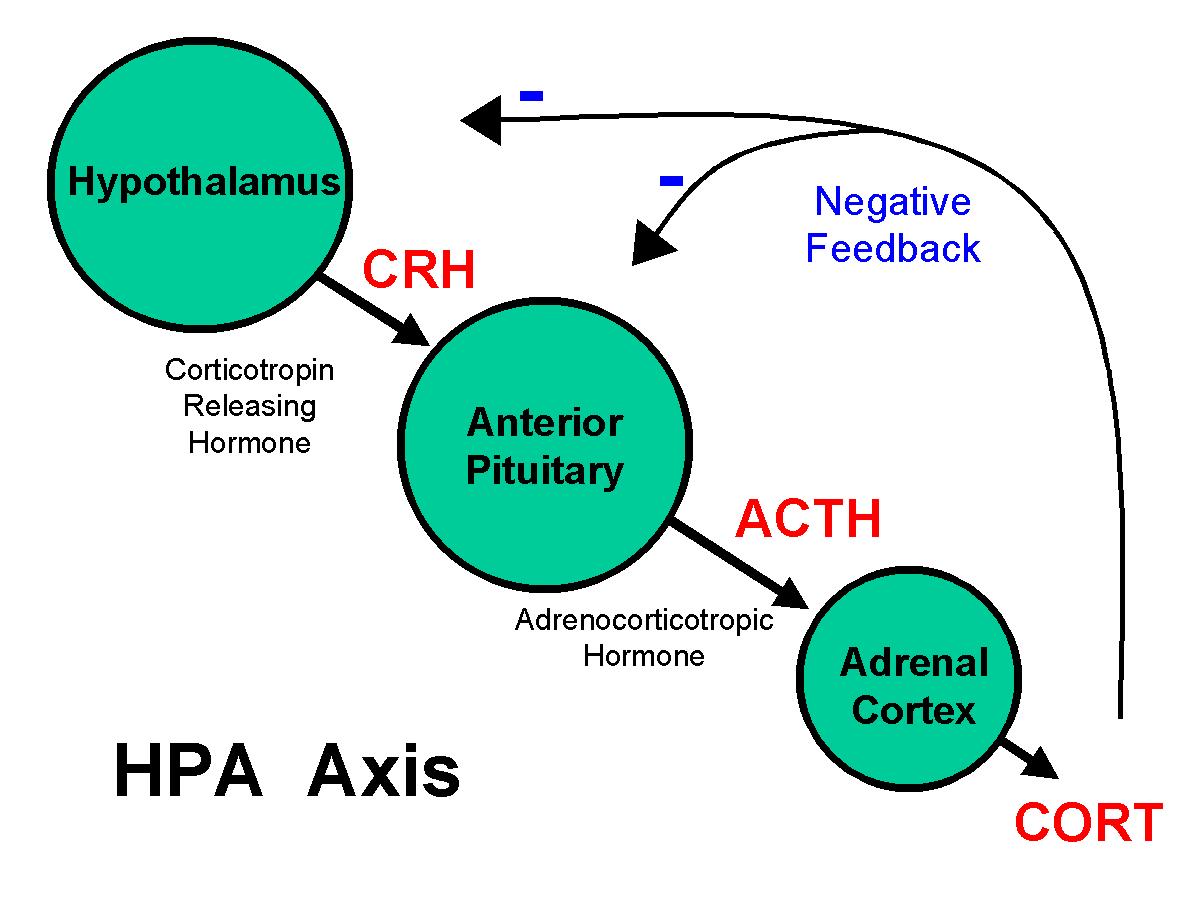
Men tend to respond to stress with a fight and flight response. When a stressor is applied, it will stimulate sensory nerve cells to pass the perception of a threat, or stress to the hypothalamus in the brain. Neurosecretory cells in the hypothalamus transmit a signal to the pituitary gland inciting cells there to release a chemical messenger into the bloodstream. Simultaneously, the hypothalamus transmits a nerve signal down the spinal cord. Both the chemical messenger and nerve impulse will travel to the same destination, the adrenal glands. Sitting atop the kidneys, the adrenal glands receive nerve and chemical signals initiated by cells in the hypothalamus. Nerve signals activate the release of epinephrine and cortisol into the bloodstream. This results in an increase in blood pressure, increase in blood sugar levels, and suppression of the immune system. This reaction will supply a boost of readily available energy for muscles throughout the body, priming them for exertion. In the lungs, epinephrine binds to receptors on smooth muscle cells wrapped around the bronchioles. This causes the muscles to relax, dilating the bronchioles and allowing more oxygen into the blood. At the sino-atrial node of the heart, epinephrine stimulates pace maker cells to beat faster. This increases the rate at which other chemical signals, glucose and oxygen are circulated to the cells that need them. Epinephrine also contracts specific types of muscle cells below the surface of the skin, causing beads of perspiration and raised hairs at the surface.
Oxytocin is a nine amino acid peptide which is involved in a wide variety of physiological and pathological functions. Two varieties are release in the body: through the blood and directly in the brain. Both have different functions. Oxytocin’s prime function with female, is to activate uterus contractions during birth and initiate lactation. It also promotes bonding between mother and offspring. Males synthesize oxytocin in the same regions of the hypothalamus as in females, and also within the testes and perhaps other reproductive tissues. Pulses of oxytocin can be detected during ejaculation. Current evidence suggests that oxytocin is involved in facilitating sperm transport within the male reproductive system, It may also have effects on some aspects of male sexual behavior.
Oxytocin is also known as the “love” hormone. A handful of new studies show that oxytocin makes us more sympathetic, supportive and open with our feelings. Oxytocin was also correlated with the longevity of a relationship. It boosts trust and empathy. Oxytocin is secreted from the hypothalamus during cuddling and physical intimacy, and increased levels of oxytocin have been shown to stimulate sexual activity in humans. It also increases skin sensitivity to touch and thus encourages or facilitates affectionate behavior.
Oxytocin is also release from the pituitary when stressors are present. It is a built in mechanism to counter all the negative conditions stress can bring on, a safety valve if you will. Studies in lab animals have shown that oxytocin administration tends to decrease the physiological and psychological aspect of stress, and the activation of the HPA axis reflex (hypothalamic-pituitary-adrenal axis).
OT = Oxytocin
Oxytocin has been shown to calm rats and humans both alike, making them less anxious and more social.
Male hormones (androgens) seem to reduce the effect of oxytocin, thus allowing for more aggressivity. The female hormone estrogen amplifies the oxytocin and thus all its effects. The UCLA team's research findings regarding those hormonal influences, were based on analysis of hundreds of biological and behavioral studies of response to stress by thousands of human and animal subjects.
Female have been found to produce more oxytocin than males. Like I previously stated, oxytocin respond differently when present with estrogen versus testosterone. This is actually very logical. With all the known effects of oxytocin, who can possible need this more than a woman in labor. Going through the stress of labor, yes gentlemen it IS extremely stressful, if a woman did not have the calming effect and instead experienced the “fight or flight syndrome’, what would happen? Would she just try to run away from the pain and stress? Would she do something drastic to relieve the pain? I remember the birth of my first child. I was told that at the peak of the contractions I actually said “hey, I changed my mind, I really don’t want to have a baby. Can we stop this now?” It was a fleeting thought that seemed logical at the time. Thinking back on it, I know the release of oxytocin kept me going. And I am so very grateful. The moment I held my beautiful son in my arms, I was quoted as having said “I want another one, just as perfect as this one”. Now who in their right mind would want to go from doing anything they can to avoid that awful pain, to wanting to go through it all over again. I’d say someone high on oxytocin.
The female combination of oxytocin and estrogen produces a “tend and befriend” response as opposed to the “fight and flight” approach of the male. A lot of women will actually try to make a connection or at least have a polite response to their attacker. If you don’t believe it, read the following excerpt from Debra Ann Davis:
“I’m 25 years old. I’m alone in my apartment. I hear a knock. I open the door and see a face I don’t know. The man scares me, I don’t know why. My first impulse is to shut the door. But I stop myself: You can’t do something like that. It’s rude.
I don’t invite him in, but suddenly he is pushing the door and stepping inside. I don’t want him to come in; he hasn’t waited to be invited. I push the door to close it, but I don’t push very hard; I keep remembering that it’s not polite to slam a door in someone’s face.
He is inside. He slams the door shut himself and pushes me against the wall. My judgment: He is very rude. I make this conscious decision: Since he is being rude, it is okay for me to be rude back. I reach for the doorknob; I want to open the door and shove him outside and then slam the door in his face, rude or not, I don’t care now. But, frankly, I don’t push him aside with much determination. I’ve made the mental choice to be rude, but I haven’t been able to muster the physical bluntness the act requires.
Or, maybe I realize the game is lost already. He is stronger than I am, I assume, as men have always been stronger. I have no real chance of pushing him aside. No real chance of it unless I’m very angry. And I’m not very angry. I’m a little bit angry.
But, despite the fact that I didn’t shove with much force, he is angry at me. I know why: It’s because I’ve been rude to him. He is insulted. I am a bit ashamed.
We fall into our roles quite easily, two people who have never met each other, two people raised in the same culture, a man and a woman. As it turns out, a rapist and his victim.”
This could possibly explain the Stockholm syndrome. The victim and kidnapper are trapped with no way out for her; her only connection to a social life is the kidnapper, he is putting her through a situation where he could easily kill or hurt her but he “generously” spares her life. She feels a tie; she feels she owes him something.
This difference in seeking social support during stressful periods is the principal way men and women differ in their response to stress, and one of the most basic differences in men's and women's behavior.
For an example in the different behavioral response to stress watch the following video of a prank. A prank can be a good scare and definitely will produce a typical stress response. Notice that most women will either freeze, run to their friend, try to go back and touch the chair, and one woman even go back and hug him (tend or befriend). Most men either take off and turn around at some distance as to prepare to defend themselves, or just plain run away (fight or flight).
Human Chair Prank
Again, is this a 100% stereotypical response experienced across the board? No, nothing ever is. There are always exceptions.I know plenty of women that are very aggressive and plenty of men who react in an opposite manner to which we would expect. There are also a lot of male and female whose hormonal level is imbalanced. Female can have too much testosterone and male can have too much estrogen. We learned earlier how the level of those two hormones will affect the body’s reaction. I don’t believe there has ever been an actual study done on this subject but I know for a fact (as a primary health care physician) that hormonal level can be very much unblanced.
I also know plenty of people who have major anger issues. Responding out of anger is a completely different can of worm. Acting like bitch does not mean you were assertive.
This blog is not about excusing women for who they are and treating them differently. If you train women in the sport aspect of martial art, do them a favor and treat them the same as you do your male students.
But if you are training women for just self-defense you HAVE to take in consideration their response to violence. If you try to teach them to respond in a manner that goes in every way against their nature, you are training them to get hurt. Use what they have to their benefit.
The best way to prepare women to defend themselves is to teach them what violence is, how predators think. If they are able to recognize this for what it truly is, they will be able to respond in a manner that will save their lives instead of getting them killed. They can be ahead of the curve.
Another thing that needs to be done is the training under stress, under pressure, the reality scenarios (properly done). Those are also invaluable tools in a woman’s self-protection arsenal.
Be smart, stay safe!
Bibliography
•
CNS Neuroscience & Therapeutic: Oxytocin: Crossing the Bridge between Basic Science and Pharmacotherapy, October 2010
•
UCLA, Biobehavioral Pattern Used by Women to Manage Stress, Science Daily May 22, 2000
•
PNAS, Testosterone Decreases Trust, June1, 2010
•
Marmara Pharmaceutical Journal 14: 61-66, 2010, Oxytocin and hypothalamo-pituitary-adrenal axis
•
Oxford Journals Medecine. Human Reproduction Update, Volume 12, issue 4, p:437-448
•
Oxytocin Effects on Human Affect and Cognition, Thesis by Allison Elizabeth Gaffey, Graduate Program in Psychology, Notre Dame, Indiana, July 2012
•
APA, A New Stress Paradign for Women, Monitor Staff, July 2000, Vol. 31, #7 page 42
•
Scientific American, February 12, 2013. By Lucianna Gravotta. Oxytocin May Help Build Long Lasting Love
•
The Franklin Institute, Resource for Science Learning, 2004, The Human Brain
•
Frontiers in Neuroendocrinology, Volume 25, Issues 3-4, September-December 2004, Pages 132-149. The Hypothaamic-neurohypophysial system regulates the hypothalamic-pituitary-adrenal axix: An Old Concept Revisited
•
The journal of NeuroScience, February 2011, CorticoTropin Releasing Factor in the Hipppocampus by Christpher Stern